Rachanaa M Raghuthama

Medicine App
‘Medicine’ is an app that is focused to make sure and design a way for communities to ensure that everyone has access to medicines. It is primarily focused on senior citizens and any other person who would need medicines regularly. The mobile app plus responsive website is designed for the social good.
Project Overview
The problem
Most of the people who are on medication will require medicines on regular basis and hence buy them every month. It was identified that eldery persons would find it difficult to go out and buy. Also those with busy schedule sometimes find it difficult to buy medicines from stores.
The goal
Build an app that is easy to use and order medicines on regular basis and get it home delivered.
My role
UX designer leading the app and responsive website design from conception to delivery.
Responsibilities
Conducting interviews, paper and digital wireframing, low and high-fidelity prototyping, conducting usability studies, accounting for accessibility, iterating on designs, determining information architecture, and responsive design.
User research : Summary
I interviewed the local elderly persons in need of medicines and other busy people under medication and found that it would help specifically these people and any other general users who would want to buy medicines online and get it home delivered.
It was found that people who purchased medicines regularly needed a more convenient and automated way of booking medicines for which the recurring order functionality was included in the app to have happy customers and provide the best user experience
Personas

Digital wireframes
After ideating and drafting some paper wireframes, I created the initial designs for the Medicine app. These designs focused on delivering personalized guidance to users to help order medicines.
Rajdutt is a 65 year old senior citizen who lives with his wife. They used to work as college professor earlier.They would like to have a dedicated app to buy medicines on time and with ease.
They get frustrated when they forget to buy medicines on time and find it difficult to go out and buy the medicines every time.
Sanjay is a 48 year old business man who lives with his wife and son. As a diabetic patient it is important for them to take medicines on time and often find it difficult to buy medicines during busy schedules. They say that sometimes they forget to buy medicines before they are out of stock at home
Low-fidelity
prototype
To prepare for usability testing, I created a low-fidelity prototype that connected the user flow of finding medicine, adding to cart and the buying procedures.I also connected the flow of re-ordering from the previous orders.

Usability study : findings
1
People want a way to recur the previous orders to make the process easier.
2
People wanted access to change delivery address and payment modes.
3
People wanted a tracking system to track their order.
Based on the insights from the usability studies, I applied design changes like providing a recurring order option so that users need not repeatedly book the same order.
Additional design changes included adding a “track my order” option to enable users to track their orders.

High-fidelity
prototype
The high-fidelity prototype followed the same user flow as the low-fidelity prototype, including design changes made after the usability study such as recurring booking options and the order tracking system.
Accesibility Considerations
Clear labels for interactive elements that can be read by screen readers.
Initial focus of the home screen on personalized buttons to help define the primary task or action for the user.
Responsive Designs
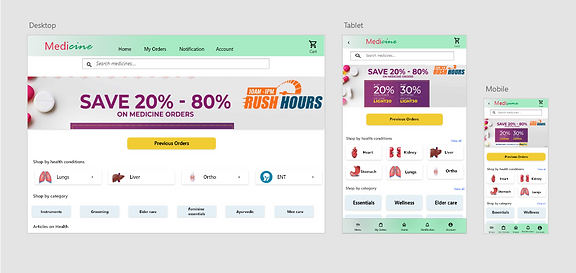
With the app designs completed, I started work on designing the responsive website. I used the Medicine sitemap to guide the organizational structure of each screen’s design to ensure a cohesive and consistent experience across devices.
The designs for screen size variation included mobile, tablet, and desktop. I optimized the designs to fit specific user needs of each device and screen size.

Takeaways and Next steps
The Impact
Users shared that the app made medicine ordering easier and the notification and recurring order options useful
What i learned
I learned that even though the problem I was trying to solve was a big one, diligently going through each step of the design process and aligning with specific user needs helped me come up with solutions that were both feasible and useful.
Future steps
Adding consultation options and lab test booking facilities through the app.
Adding feature of a Doctor bot for quick tips on health issues.